Counting Greek Americans: Birthplace, Ancestry, and Change
What American Community Survey data from 2010–24 reveal about birthplace & ancestry
Greek American demographics
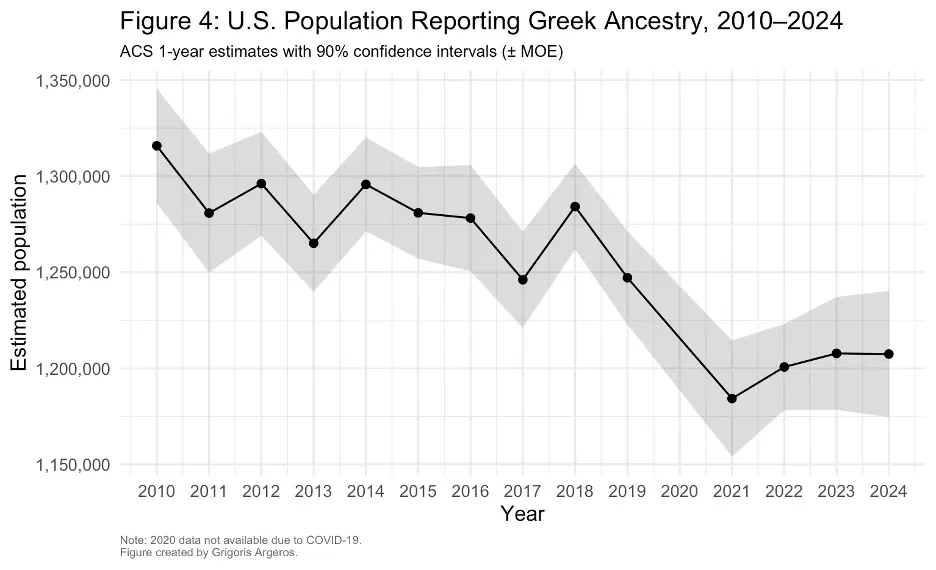
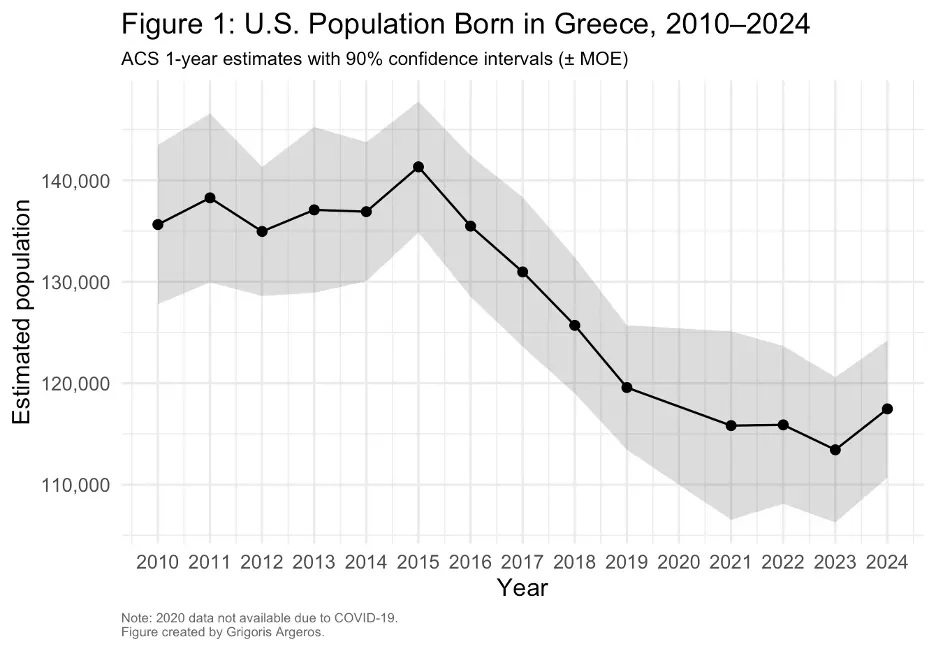
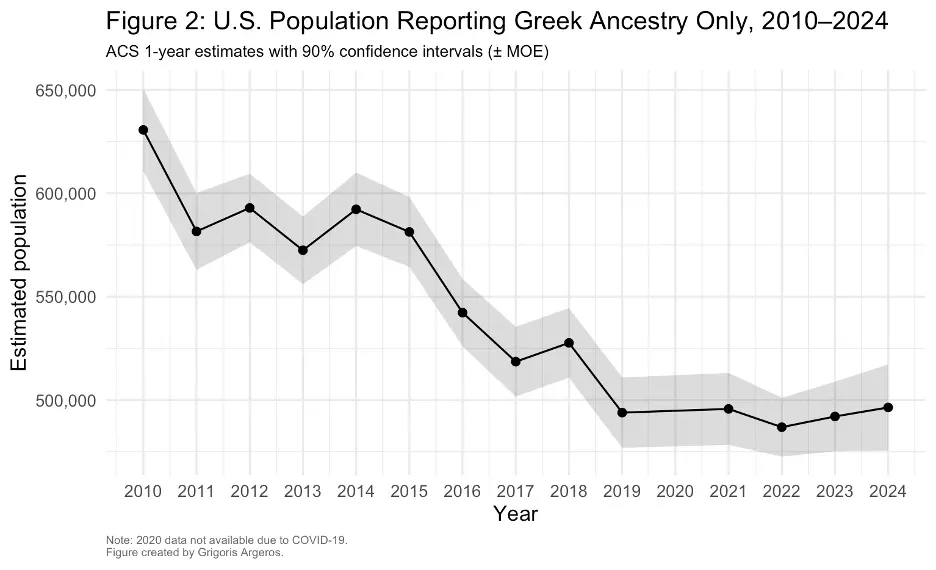
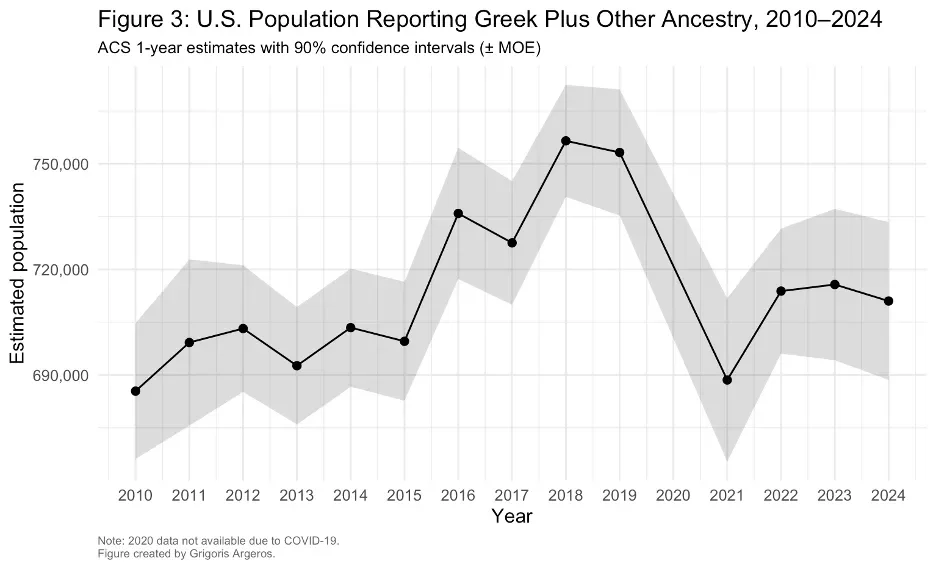
This post provides a descriptive statistical snapshot of Greeks in the United States from 2010 to 2024. It uses information on place of birth and ancestry from the American Community Survey (ACS) 1-year estimates. The most recent data available come from the 2024 ACS Public Use Microdata Sample, released by the U.S. Census Bureau in December 2025. The following four figures provide an approximate picture of how the Greek-American population has changed over time, depending on which factor is used to define it: place of birth or ancestry.
Overall, Figures 1-4 reveal that demographic change among Greek Americans has not been uniform. While the population born in Greece and those reporting only Greek ancestry have declined, individuals reporting Greek ancestry alongside other ancestries have remained more stable. As a result, when these two groups are considered together, the total population reporting Greek ancestry, whether alone or in combination with other ancestries, has declined more modestly. These patterns suggest that recent changes reflect not only population loss but also shifts in how Greek-Americans are identified.
Before continuing, it’s worth noting that this piece does not try to define Greek-American identity in cultural or subjective terms. Questions about identity and belonging are beyond the scope of this post. The focus is strictly on quantitative measures that provide demographic context for broader discussions of the Greek-American community.
1. Place of Birth: Greece (Greek-born Population)
The number of Greece-born residents in the U.S. remained relatively stable between 2010 and 2015, but declined more sharply thereafter.
In 2010, the ACS estimated 135,639 Greek-born individuals living in the United States. By 2024, that number had declined to 117,468, a roughly 13 percent decrease. The difference is statistically significant given the combined margin of error. See Figure 1 below.
2. Single Ancestry (“Greek Only”)
Among those reporting only Greek ancestry, the decline is more pronounced than among those identified only by place of birth (Figure 1). Between 2010 and 2024, the estimated population fell from 630,660 to 496,417, a decrease of just over 134,000 people, or approximately 21%. This change is statistically significant given the combined margin of error. See Figure 2.
3. Multiple Ancestry (“Greeks Plus Other Ancestries”)
The number of people reporting Greek ancestry alongside another ancestry appears to have increased moderately over the period, from 685,414 in 2010 to 711,008 in 2024, corresponding to an approximately 4% increase. To the extent that we see an absolute increase in the persons reporting multiple ancestries through the late 2010s, followed by a decline after 2019, these changes are not statistically significant. See Figure 3.
4. Total Greek Ancestry (Alone or in Combination with Other Ancestries)
The last figure, Figure 4, shows the trend in the total population reporting Greek ancestry, whether alone or in combination with other ancestries. Between 2010 and 2024, the estimated number declined from 1,315,775 to 1,207,425, representing a roughly 8% decrease. Despite the yearly fluctuations, the overall decline from 2010 to 2024 is statistically significant. See Figure 4.